Category: Speech Delay

10 Missed Clues of Autism in Childhood That Finally Make Sense

Can I tell you something?
When I hear childhood stories like being called “ziddi” or how your mom ran behind you with roti and sabzi because you would only eat curd rice or plain paratha it makes me pause. We often laugh at these stories, but for some children, these patterns are not just quirks. They might be hidden signs of something deeper.

This blog is for parents. Especially those who’ve heard people dismiss their concerns with lines like, “Bachcha hai, thoda ziddi toh hoga hi,” or “Sab theek ho jaayega, abhi chhota hai.” I know how confusing it is when you sense something is different about your child, but society brushes it aside. That in-between space—where your instincts say one thing and others say another—is often the hardest.

The purpose of this blog is not to label your child, but to create awareness. To shine light on the small, often-missed signs of autism in early years. Because the sooner we understand, the sooner we can support. Many children with autistic traits go unnoticed simply because their behaviors are mistaken for stubbornness, shyness, or “just being different.”

So if you’ve ever felt your child’s behaviors don’t add up—or if you’ve been made to doubt your own concerns read on. This piece is here to give you clarity, reassurance, and a new lens to look through.

Because the sad truth is, many autistic children in India grow up misunderstood. Their pain gets dismissed, their sensitivities get ridiculed, and their struggles are treated as drama or disobedience. Years later, when the puzzle pieces finally come together, parents often feel guilty: “Why didn’t we see it sooner?”

I don’t want you to carry that guilt. This isn’t about blame, it’s about awareness. About realising that what society wrote off as laziness, stubbornness, or “bad upbringing,” might have been your child’s brain asking for help.

So, through this blog, let’s walk through some of those hidden signs. Let’s reframe the story so instead of saying “Arre, ye bachcha ajeeb hai”, we start saying “Wait, maybe there’s more going on here.”

Photo by Maximus Beaumont on Unsplash

Childhood Signs We Usually Dismiss in India

  1. Food fussiness (a.k.a. “Bahut nakhre karta hai!”)
    Every Indian child is scolded for being choosy with food. But imagine if it wasn’t just stubbornness. For some kids, it’s sensory. Like the dal ka smell makes them gag, or the mushy texture of bhindi feels unbearable. Research shows that almost 89% of autistic kids have food challenges. So that child who only ate Maggi or bread wasn’t “spoiled”—their brain just couldn’t process certain tastes or textures.
  2. Hating noise (a.k.a. “Kya nautanki hai, sabko toh maza aata hai!”)
    Think about Diwali crackers, Ganpati visarjan dhols, or even that one uncle who shouted into the mic at weddings. Most kids jumped in excitement, but you maybe covered your ears, cried, or run inside. That wasn’t drama—it was sensory overload.
  3. Meltdowns mistaken for drama.
    In school, when a teacher shouted or homework felt overwhelming, you might have broken down crying. And people said, “Arre, itna bada ho gaya, still crying like a baby.” But autistic kids’ nervous systems get overloaded quickly. Meltdowns aren’t drama; they’re genuine distress.
  4. Social quirks in school.
    Maybe you didn’t have a big gang. You had one best friend, and if that friend was absent, you sat alone. Or you copied how others behaved so you wouldn’t be left out. In India, that gets labelled as “shy” or “introvert,” but it could actually be masking—pretending to be “normal” to fit in.
  5. Obsessions and routines.
    Remember how you lined up cricket cards, or refused to change your timetable of study, or got upset if someone shifted your toys? Parents laughed and called it “weird habits.” But those routines were your way of feeling safe and in control.

And there are many others—late speech (being teased for “bolne mein late”), handwriting issues (“doctor’s handwriting hai kya?”), or not making eye contact with elders (“dekho toh, aankh mila ke baat karo”). In Indian homes, these become points of scolding or jokes. But actually, they’re red flags we miss.

Photo by Caleb Woods on Unsplash

Why This Matters for You

Because maybe you’ve carried those same memories.

  • Being forced to eat what you couldn’t handle.
  • Relatives saying “yeh bachcha normal nahi lagta.”
  • Teachers are labelling you “lazy” when you just processed information differently.
Photo by Chinh Le Duc on Unsplash

The Takeaway

Looking back at childhood through this lens is healing. It helps you connect the dots and understand:

  • That stubborn child wasn’t difficult—they were sensitive.
  • That quiet student wasn’t anti-social—they were overwhelmed.
  • That picky eater wasn’t pampered—they were struggling with sensory overload.

If any of these challenges feel familiar for your child, know that you’re not alone. Our team is here to help you understand what’s going on and create a personalized approach that truly supports your child. You can schedule a visit with us either at the clinic or online, whichever feels easiest for you.

School Refusal or Real Anxiety? A Parent’s Guide to What’s Really Going On

“Every morning, it breaks my heart…”

If you’re a parent walking away from school drop-off with a heavy heart because your child is still crying or clinging to you, let me begin by saying—I understand. You’re not alone. And what you’re seeing is not bad behaviour. It’s not stubbornness. It’s real emotional distress, often rooted in the developing brain, early experiences, and your child’s unique temperament.

Let’s walk through this together—scientifically, psychologically, and with deep empathy.

When Is Separation Anxiety a Concern?

It’s normal for young children, especially between 18 months and 5 years, to feel anxious when separated from their caregivers. But when this anxiety:

  • Lasts beyond 4–6 weeks of regular school attendance,
  • Begins to interfere with sleep, appetite, or learning,
  • Or escalates instead of settling down.
  • It may be more than just a “phase.”

Let’s look deeper at what could be causing this.

What Could Be Going On in Your Child’s Mind and Body?

1. Insecure Attachment Patterns

Children thrive on consistency. If caregiving has been unpredictable—due to frequent changes in caregivers, emotional unavailability, or inconsistent routines—children may struggle to feel safe when away from their secure base.

2. Highly Sensitive Temperament

Some children are biologically wired to feel more deeply. They’re more sensitive to noise, change, unfamiliar faces, or transitions. For these children, a school setting can feel emotionally overwhelming.

3. Parental Anxiety or Overprotection

Children mirror our emotional energy. They might internalize this fear if you’re anxious during drop-offs or hesitant to let them explore. Indian parenting styles often emphasise protection, but sometimes, unintentionally, this delays a child’s confidence to separate.

4. Past Stressful Experiences

Even one difficult experience—like an illness, hospitalisation, or abrupt change in the caregiving environment—can leave an emotional imprint. A child may begin to associate separation with distress or danger.

5. Lack of Gradual Exposure

Many children today enter preschool without prior exposure to playgroups, time with extended family, or moments away from their parents. The sudden shift to a structured environment can feel abrupt and scary.

6. Poor Emotional Regulation Skills

Your child’s brain is still under construction, especially the part that calms big emotions. Until this matures, they rely on external support (you!) to feel safe. Meltdowns often signal that they don’t yet have the internal tools to cope.

7. Delays in Language or Social Development

If a child struggles to express their needs or connect with peers, school may feel isolating. They may act out simply because they can’t say, “I feel scared,” or “I don’t know what’s going on.”

8. Separation Anxiety Disorder (SAD)

In about 4–5% of children, the distress is intense and clinically significant. These children experience persistent worry, physical symptoms, and a strong fear of harm. In such cases, a professional child psychologist can offer tremendous support.

What You Can Do — Practical, Heart-Based Solutions

 Stay Regulated Yourself

Children sense everything. Your calmness is the foundation for their calm. If you feel nervous, practice deep breathing or grounding techniques before drop-off.

 Build Predictable Routines

Children find safety in rhythm. Wake, dress, eat, and travel to school in the same order each day. Visual schedules with pictures also help children know what to expect.

 Say a Warm, Predictable Goodbye

Never sneak away. That breaks trust. Instead, use a consistent goodbye ritual (a hug, a phrase like “I’ll be back after tiffin”) to build reassurance.

 Use Transitional Comforts

A small object with your scent, a photo, or a love note tucked in their pocket can ease the gap between home and school.

 Stay in Touch With Teachers

Often, children settle within minutes of your leaving. Regular communication helps you stay informed and reduce your worry.

 Use Stories to Process Feelings

Books like The Kissing Hand or Indian stories about brave little animals help children feel understood and validated.

 Know When to Seek Help

Red flags include:

  • Daily meltdowns that don’t improve over time
  • Regressions like bedwetting or thumb-sucking
  • Frequent physical complaints like stomach aches
  • Silence or withdrawal when asked about school

When to Consider a Developmental Evaluation

If your child also:

  • Has trouble with speech or comprehension
  • Struggles to make eye contact
  • Can’t follow routines or transitions easily
  • Is unusually fearful of new spaces or people

 It might be time to consult a child development specialist. Early support can transform your child’s school journey.

How Homeopathy Can Help

In my clinical practice, I’ve seen many children benefit from homeopathy in ways that complement behavioral and emotional support:

  • Reduced nervousness and irritability
  • Improved sleep and appetite
  • Better adaptation to change

Homeopathy doesn’t suppress symptoms—it supports the child’s inner balance. Through constitutional treatment tailored to your child’s emotional and physical profile, we gently help their nervous system regulate.

To Every Loving Parent Reading This…

If your child cries at school drop-off, it’s not your fault. You haven’t “failed” at parenting. And your child isn’t misbehaving.

You’re both going through a growth journey of trust, independence, and love.

Give it time. Be consistent. Ask for help when needed.

And most importantly—remember, you’re not alone in this.

A Doctor’s Guide to Early Signs of Autism, ADHD & Learning Issues in Indian Kids

Apna bachpan yaad hai? Hamare parents ne kai baar bola hoga — “Bachpan mein sabhi aise hote hain, theek ho jaayega.” And honestly, unki baat mein pyaar toh tha, lekin aaj ke zamane mein sirf pyaar kaafi nahi hai — clarity bhi zaroori hai.

This question, “Is it just a phase?”, is one of the most common and important doubts I hear from parents. And if you’ve been wondering the same about your child, aap akelay nahi ho.

Let’s break it down together — one step at a time. Scientifically. Compassionately. No jargon. Just a real conversation that might bring you clarity and peace

Sabhi bachhe alag hote hain — True or just comfort talk?

Yes — it’s true that every child develops at their own pace. Some walk at 10 months, some at 15. Some speak by 1.5 years, others by 2. But there’s a range of normal. Science calls these developmental milestones — important markers to help us catch when a child might need extra support.

For example, if your child is:

    • Not making eye contact
    • Doesn’t respond to name by 12 months
    • Is not pointing or waving by 15 months
    • Hasn’t spoken meaningful words by 18–24 months
    • Repeats phrases but doesn’t use them to communicate
    • Can’t sit still for even a few minutes
    • Lines up toys, flaps hands, or avoids interaction

Yeh sirf “alag” hona nahi hai — yeh developmental red flags ho sakte hain. Not labels, not judgments — just signals. Aur jitni jaldi hum in par kaam karein, utna accha outcome hota hai.

It’s Not Just Behavior — It’s Brain Wiring

Neurodevelopmental disorders — like Autism Spectrum Disorder (ASD), Attention Deficit Hyperactivity Disorder (ADHD), and Learning Disabilities (LD) — parenting se nahi hote. Inka base hota hai brain wiring, genetics, sometimes early birth-related complications or environmental influences.

Indian parents often hear or think:

  • “Ladka hai, isliye late bol raha hai.”
  • “Ghar mein sab late bolte hain.”
  • “Shayad TV zyada dekh liya.”
  • “Main working mom hoon, meri wajah se toh nahi?”

Please remember: Blame doesn’t help. Awareness does. Yeh kisi ka fault nahi hai — but knowing early helps us give the child the right tools to thrive.

Why Waiting Can Hurt

Kai baar relatives ya even doctors bolte hain, “Waqt ke saath theek ho jaata hai.”

But science tells us something else. The brain is most adaptable — neuroplastic — in the first 5–6 years of life. After that, it’s like clay that begins to harden.

Studies show that children who receive support before the age of 3 show significantly better long-term outcomes in language, attention, behavior, and social development.

But what if I’m overthinking?

That’s a genuine fear many parents share — “Kahi main overreact toh nahi kar rahi?”

Think of it this way — agar aapke bacche ko blurred vision ho, aap uska eyesight test karwaate ho na? Evaluation means clarity. If everything’s fine, you get peace. If there’s a concern, you get time to act.

How Can Homeopathy Help — Scientifically?

Once we know what we’re dealing with, the next step is support.

This is where integrative care, including homeopathy, comes in. Now, I want to be very clear — homeopathy is not a replacement for therapies like speech, occupational therapy, or special education. But what it does offer is internal support to the child’s nervous system.

Homeopathic medicines are selected based on the child’s complete symptom picture — not just the diagnosis, but the child’s unique personality, fears, sleep, digestion, and emotional responses.

Emerging research shows that:

  • Homeopathy can help regulate sensory processing, especially in hypersensitive children.
  • It may help in improving sleep, anxiety, attention span, and emotional control — all crucial for learning.
  • Children receiving homeopathic care alongside therapies often show faster emotional settling and better engagement in sessions.

The goal is not to “cure” the child — the goal is to support their nervous system, reduce stress responses, improve adaptability, and gently assist development from the inside out.

Most importantly, homeopathy is safe, gentle, and non-toxic, making it ideal for growing brains and bodies.

What You Can Do Today

Start observing and noting patterns in your child over a few weeks.

Consult a developmental expert, not just a general pediatrician.

Don’t delay screening — tools like M-CHAT or Conners Scale are simple and available in many clinics.

Consider integrative support, including homeopathy, alongside therapy.

Trust yourself. You know your child best.

From Confusion to Clarity

I’ve seen non-verbal 3-year-olds become confident communicators.

I’ve seen children once lost in their own world slowly but surely begin to respond, connect, and even shine.

Kya yeh overnight hua? Nahi. Yeh hua because parents didn’t ignore their doubts — they acted on them.

So if you’re asking yourself, “Is this just a phase?” — it’s time to trust that instinct. Because early action is not fear — it’s faith in your child’s potential.

Let’s make decisions not out of panic, but out of informed compassion.


Mumma, Papa… Why Isn’t He Talking Yet?

If you’re reading this, chances are… you’re concerned about your child.

Maybe your toddler isn’t talking like other children their age.
Maybe they avoid eye contact, don’t respond when you call their name, or spend hours lining up toys instead of playing pretend.
Maybe you’ve heard someone say, “It’s just a phase,” but your gut says otherwise.

As a parent, your instinct is powerful. And you’re right to listen to it.

At Caitanya, I’ve met countless mothers and fathers who noticed something early on — even if they couldn’t quite put it into words. What matters is: you noticed. That’s the beginning of everything.

So, what could these early signs mean?
Could it be a temporary delay — or is it pointing to something deeper?

Let’s understand one of the possibilities that many parents today are navigating with strength, awareness, and love — Autism Spectrum Disorder.

What Is Autism?

Autism Spectrum Disorder (ASD) is a neurodevelopmental condition, which means it affects how a child’s brain grows and understands the world.

It’s not a disease, not something “caught,” and certainly not the parent’s fault.
It’s a difference in brain wiring — in how your child learns, plays, feels, and interacts.
And it can influence more than just speech or behavior. Many children with autism may also experience differences in:

  • Communication – speaking, using gestures, or understanding others
  • Social interaction – forming relationships or playing with peers
  • Sensory processing – how they respond to sounds, touch, smells, light
  • Emotional regulation – managing excitement, frustration, or routine changes
  • Physical health – sleep disturbances, digestive issues, food intolerances

Importantly, autism exists on a spectrum — every child presents differently.

 Early Signs Parents Should Watch For

You, as a parent, are often the first to observe something “different.” These signs can appear as early as infancy, or may become noticeable by 18–24 months.

 Baby and Toddler Signs

  • Doesn’t respond to name being called
  • Avoids eye contact
  • Doesn’t smile back or react to peekaboo
  • Rarely gestures (waving, pointing, showing objects)
  • Doesn’t babble, coo, or attempt early speech sounds
  • Doesn’t reach out to be picked up

 Social and Play Behaviors

  • Prefers to play alone; avoids peers
  • Doesn’t imitate actions (clapping, playing house, etc.)
  • Lines up toys or spins objects
  • Doesn’t show shared enjoyment (like pointing to something exciting)
  • May seem unaware of others’ emotions or expressions

 Sensory & Physical Cues

  • Overreacts to common sounds (pressure cooker, mixer)
  • Sensitive to clothes tags, water temperature, or bright lights
  • Repeats unusual behaviors like spinning, hand-flapping, or toe-walking
  • May chew on non-food items or repeat specific sounds
  • Either extremely active or unusually quiet

 Let’s Clear Some Myths

In Indian households, we often hear:

  • “Boys talk late, don’t worry.”
  • “He’s just naughty, not autistic.”
  • “She doesn’t speak because no one else talks to her at home.”

While these comments come from a good place, they can delay timely support.

Autism isn’t caused by parenting style, screen time, or vaccines.
It’s a biological-neurological condition — not a character flaw or a bad habit.

The earlier we identify it, the better the outcome.

 Why Early Intervention Matters

The first few years of life are when the brain is most adaptable — this is called neuroplasticity. During this time, the right support can help your child:

  • Build social understanding
  • Develop communication skills (verbal or non-verbal)
  • Learn daily routines and self-care
  • Reduce overwhelming behaviors
  • Strengthen emotional connection and bonding

We’ve seen beautiful transformations:
Children who once had no words begin to speak in full sentences.
Children who couldn’t bear touch now enjoy hugs and closeness.
Families once lost in confusion now feel hopeful, connected, and empowered.

 What’s Next?

If you’ve noticed any of the signs above, don’t panic.
But don’t wait either.

Every child develops differently — yes — but certain milestones are important signals. If your child seems to be missing multiple early milestones, it’s time to evaluate further.

A proper diagnosis doesn’t put a label on your child. It opens the door to support, therapy, and real change.

Our Approach at Caitanya Healing by Homeopathy

At Caitanya, we offer a specialized, system-based approach to support children with autism.

We combine:

  • Classical homeopathic treatment tailored to your child’s constitution
  • Evidence-based therapies to enhance sensory processing and focus
  • Parental coaching for home routines and behavior strategies
  • Nutritional guidance to support gut-brain health
  • And most importantly, compassionate, personalized care

Concerned About Autism? Let’s Evaluate, Not Assume.

If you’re unsure whether your child is showing signs of autism or simply facing a temporary delay, early assessment is key.

 Book a free one-on-one consultation with Dr. Rajeshwari:
👉 https://calendly.com/doctorsconsultation/free-one-to-one-consulting-dr-rajeshwari

We offer evidence-based guidance, developmental screening, and a clear path forward — without fear, stigma, or guesswork.

Early action isn’t about labeling — it’s about timely support and better outcomes.
Let’s take that step, together.

Speech Delay in Children: How Homeopathy Can Help

Is Your Child Facing Speech Delay? Let’s Talk About It

As a parent, it can be worrying if your child isn’t talking as expected. Maybe they’re not saying words yet, or they struggle to put sentences together. You might be wondering—why is this happening? What can you do to help? Let’s break it down in simple terms and explore how homeopathy can play a role in supporting your child’s speech development.

Prevalence of Speech Delay in India

Recent studies in India have reported varying prevalence rates of speech and language delays among children:-

  • A study conducted in North India found a prevalence of 6.2% among children .
  • Another study reported a prevalence of 7% in children aged 0-3 years .​
  • Research from South India indicated a prevalence of 13.7% in children up to six years of age .

What is Speech and Language Delay?

Speech and language delay happens when a child doesn’t start talking or understanding words at the expected age. It’s more common than you might think, affecting about 5-10% of preschool-aged children.

  • Speech is about making sounds and words clearly.
  • Language is about understanding and using words to communicate.

Some children may have difficulty with one or both, which can lead to frustration—for both them and you.

Why is My Child Facing a Speech Delay?

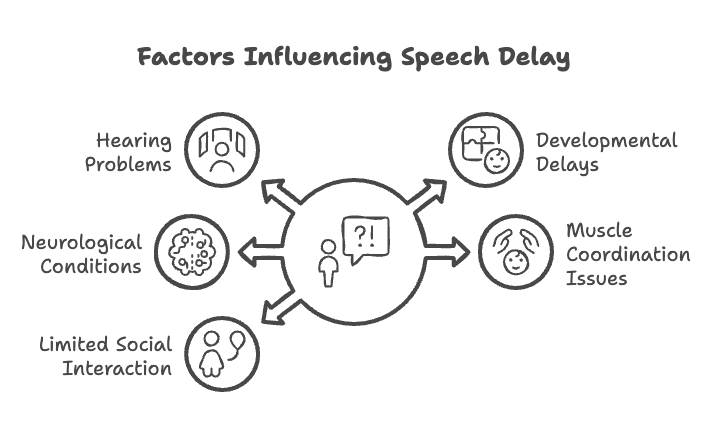
There isn’t just one reason. Many factors can influence speech development, such as:

  • Hearing problems: If your child struggles to hear clearly, learning to talk becomes harder.
  • Developmental delays: Some conditions, like autism or ADHD, can slow speech development.
  • Neurological conditions: The brain and nervous system play a big role in speech. Any delays in these areas can affect communication.
  • Muscle coordination issues: Speaking requires precise control of the lips, tongue, and jaw. Weakness or poor coordination can make speech difficult.
  • Limited social interaction: If a child doesn’t hear enough spoken language or isn’t encouraged to express themselves, their speech development may be slower.

How Can You Tell if Your Child Has a Speech Delay?

Every child develops at their own pace, but here are some common signs to watch for:

  • By 12 months: Not babbling or making simple sounds.
  • By 18 months: Not saying single words like “mama” or “dada.”
  • By 2 years: Not combining two words like “want toy.”
  • Difficulty understanding you or following simple instructions.
  • Struggling to express needs or getting frustrated when trying to communicate.
  • Unclear pronunciation that makes it hard for others to understand them.

If any of these sound familiar, don’t panic—there are ways to help!

What Can You Do to Help Your Child?

The good news is that speech delays can often be improved with the right approach. Some important steps include:

  • Encouraging conversation: Talk to your child often, even if they’re not talking back yet.
  • Reading together: This helps build vocabulary and understanding.
  • Play-based learning: Playing with toys, singing songs, and engaging in interactive games all support language development.
  • Speech therapy: A professional speech therapist can help guide your child’s speech growth.
  • Providing a supportive environment: Be patient and give your child plenty of opportunities to express themselves.

How Can Homeopathy Help?

Many parents turn to homeopathy as a natural way to support their child’s speech development. Homeopathy doesn’t just focus on the symptoms—it looks at the child as a whole, including their emotional well-being, behavior, and neurological development.

Here’s How Homeopathy Works:

  • Supports Brain and Nerve Function: Homeopathy works to balance the nervous system, helping the brain process speech more effectively.
  • Improves Muscle Coordination: Speech requires control of the tongue, lips, and jaw. Homeopathy can help improve muscle tone and coordination, making it easier for your child to form words.
  • Helps in Developmental Delays: If speech delay is linked to conditions like autism or ADHD, homeopathy supports overall cognitive and emotional development.
  • Reduces Anxiety and Frustration: Speech delays can be frustrating for children, leading to behavioral challenges. Homeopathy helps children feel calmer and more confident in expressing themselves.
  • Stimulates Natural Development: Instead of forcing speech, homeopathy gently encourages the body to develop speech skills at its own pace.

A Holistic Approach to Speech Development

No single solution works for every child, but combining homeopathy with speech therapy, a language-rich environment, and emotional support can make a real difference. Every child’s journey is unique, and progress may take time—but with the right approach, improvements can be seen.

Final Thoughts

If your child is facing speech delays, you’re not alone. Early intervention, a nurturing environment, and natural approaches like homeopathy can help them find their voice. If you’re considering homeopathy, consult with a qualified homeopath to find the best support for your child’s needs.

Remember, every child learns at their own pace. With patience, encouragement, and the right help, your child can develop strong communication skills and thrive.